
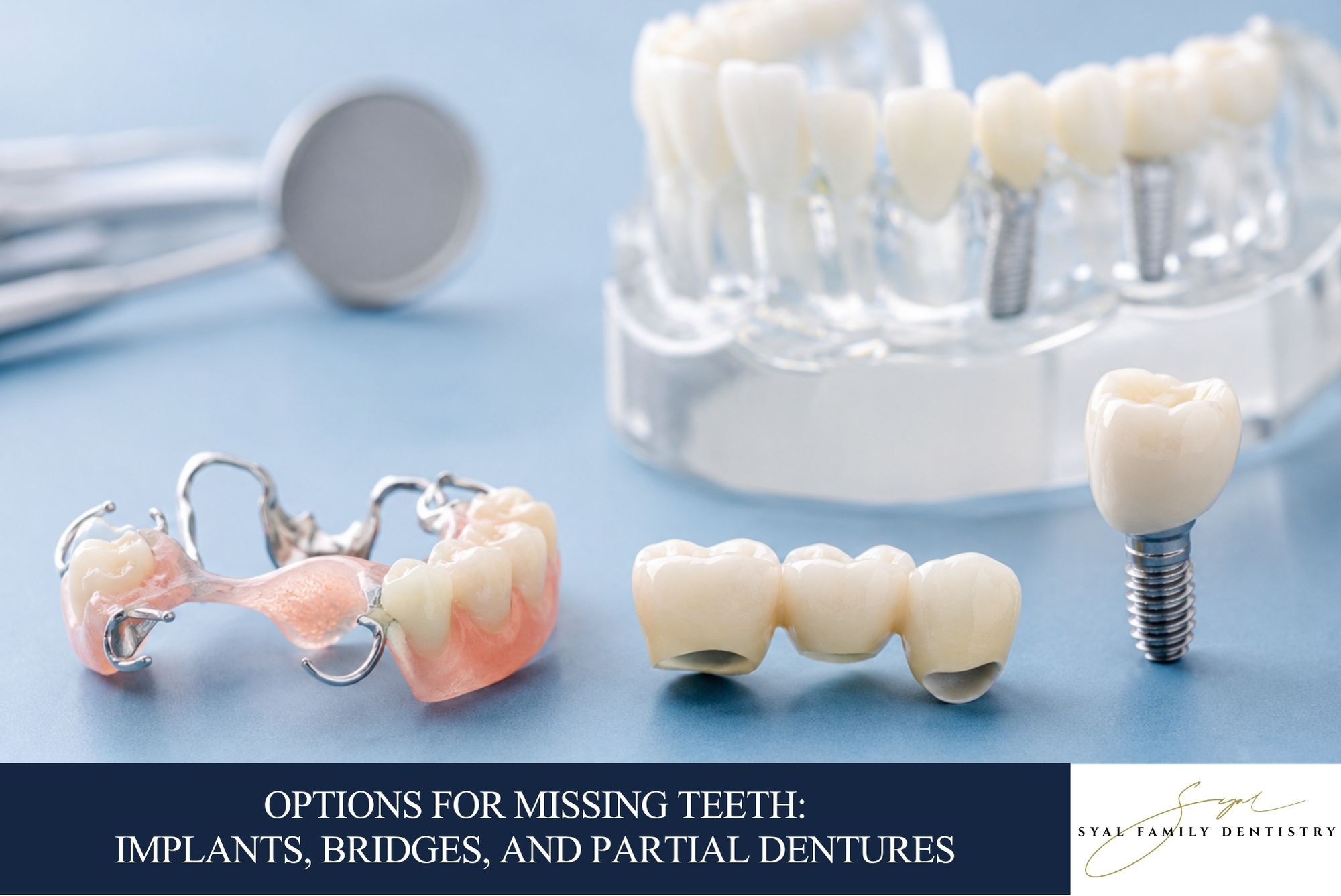
 Losing one or more teeth can affect much more than your appearance. Missing teeth can make it difficult to chew comfortably, speak clearly, and maintain proper oral health. Over time, the surrounding teeth may begin to shift, your bite can change, and the jawbone beneath the missing tooth may gradually shrink. Fortunately, modern dentistry offers several effective solutions to restore your smile and protect your long-term oral health.
At Syal Family Dentistry, we help patients in Santa Rosa, CA, choose tooth replacement options that fit their oral health needs, lifestyle, and budget. Whether you are missing a single tooth or several teeth, treatments such as dental implants, dental bridges, and partial dentures can restore your smile while improving comfort, confidence, and function.
Why Replacing Missing Teeth Is Important
Many people assume that replacing a missing tooth is primarily a cosmetic decision. While restoring your smile certainly improves confidence, replacing missing teeth also provides significant health benefits.
When a tooth is lost, the neighboring teeth often begin to drift into the empty space. This movement can lead to bite problems, uneven tooth wear, jaw discomfort, and increased difficulty cleaning between teeth. Missing teeth also reduce chewing efficiency, which may affect your ability to eat a balanced diet.
One of the most important concerns is bone loss. The roots of natural teeth stimulate the jawbone whenever you chew. Without that stimulation, the bone gradually deteriorates, potentially changing your facial appearance and making future tooth replacement more complex.
Replacing missing teeth early helps preserve your smile, improve oral function, and reduce the risk of additional dental problems.
Understanding Your Tooth Replacement Options
Today’s restorative dentistry offers several excellent solutions for replacing missing teeth. Each option has unique advantages, and the best choice depends on factors such as the number of missing teeth, jawbone health, adjacent teeth, and personal preferences.
At Syal Family Dentistry, we carefully evaluate every patient’s needs before recommending treatment.
Dental Implants
Dental implants are an excellent option for many appropriate patients because they replace both the tooth root and the visible crown, providing a stabl, natural-looking, and long-lasting solution for missing teeth.
An implant consists of a small titanium post that is surgically placed into the jawbone. After the implant integrates with the bone through a natural healing process called osseointegration, a custom dental crown is attached to create a beautiful, functional replacement tooth.
Dental implants offer numerous benefits:
- Look and feel like natural teeth
- Preserve jawbone health
- Prevent neighboring teeth from shifting
- Do not require altering healthy adjacent teeth
- Provide excellent chewing strength
- Can last for decades with proper care
Dental implants are ideal for replacing one tooth, multiple teeth, or even supporting full-arch restorations in appropriate candidates.
Dental Bridges
Dental bridges replace one or more missing teeth by anchoring an artificial tooth between neighboring natural teeth or dental implants.
Traditional bridges involve preparing the adjacent teeth to support custom dental crowns that hold the replacement tooth securely in place.
Benefits of dental bridges include:
- Fixed, non-removable restoration
- Restores chewing ability
- Improves appearance
- Prevents shifting of nearby teeth
- Typically completed in fewer appointments than implant treatment
Dental bridges remain an excellent option for patients who may not be candidates for dental implants or who prefer a fixed restoration without surgery.
Partial Dentures
Partial dentures are removable appliances designed to replace several missing teeth while preserving the remaining healthy teeth.
Modern partial dentures are more comfortable, lightweight, and natural-looking than older designs. They consist of replacement teeth attached to a durable framework that fits securely around your remaining natural teeth.
Partial dentures offer several advantages:
- Cost-effective tooth replacement
- Replace multiple missing teeth
- Non-surgical treatment
- Can be adjusted if additional teeth are lost later
- Improve chewing and speaking ability
For many patients, partial dentures provide an excellent balance between affordability and function.
Comparing Implants, Bridges, and Partial Dentures
Choosing the right treatment involves understanding how each option compares.
Longevity
Dental implants generally offer the longest lifespan when properly maintained. Many implants last several decades or longer.
Dental bridges often last 10 to 15 years or more with excellent oral hygiene and regular dental care.
Partial dentures typically require adjustments or replacement over time due to normal wear and changes in the mouth.
Appearance
All three treatment options can produce attractive, natural-looking smiles.
Dental implants often provide the most realistic appearance because they emerge directly from the gums like natural teeth.
Dental bridges also create seamless aesthetics, while today’s partial dentures are significantly more lifelike than older removable appliances.
Comfort
Because dental implants function like natural teeth, many patients find them to be the most comfortable option.
Dental bridges also provide excellent stability because they remain fixed in place.
Partial dentures require an adjustment period, but most patients become comfortable wearing them after consistent use.
Oral Health Benefits
Dental implants uniquely stimulate the jawbone, helping prevent bone loss.
Bridges maintain spacing between teeth but do not prevent bone shrinkage beneath the missing tooth.
Partial dentures restore function but also do not provide direct bone stimulation.
Are Dental Implants Right for Everyone?
Dental implants are an outstanding option for many patients, but not everyone is immediately ready for implant placement.
Successful implant treatment requires:
- Healthy gums
- Adequate jawbone support
- Good overall health
- Commitment to excellent oral hygiene
Patients with bone loss may still qualify for implants after procedures such as bone grafting. During your consultation, your dentist will evaluate your oral health, review your medical history, and discuss the most appropriate treatment options.
Factors to Consider When Choosing a Tooth Replacement
Every smile is unique, and several factors influence which restoration is best.
Important considerations include:
Number of Missing Teeth
Replacing a single missing tooth often differs from restoring several missing teeth or an entire arch.
Bone Health
The amount of available jawbone affects implant candidacy and long-term success.
Budget
Each treatment option has different upfront costs and long-term value. While dental implants often require a greater initial investment, their longevity may provide excellent value over time.
Lifestyle
Some patients prefer removable appliances, while others desire fixed restorations that closely resemble natural teeth.
Long-Term Goals
Your dentist will help you balance your current needs with your future oral health goals to develop a personalized treatment plan.
Maintaining Your New Smile
Regardless of which restoration you choose, proper maintenance helps maximize longevity.
Good habits include:
- Brushing twice daily
- Flossing or cleaning around restorations as instructed
- Attending regular dental cleanings and examinations
- Avoiding tobacco products
- Wearing a nightguard if you grind your teeth
- Seeking prompt treatment for gum disease or other oral health concerns
Routine preventive care helps protect both your natural teeth and your dental restorations.
Comprehensive Restorative Dentistry in Santa Rosa, CA
At Syal Family Dentistry, we understand that every patient’s needs are different. Our team provides personalized treatment recommendations designed to restore your smile, improve oral health, and enhance your quality of life.
Whether you need dental implants, crowns, bridges, gum disease treatment, root canal treatment, clear aligners, or an emergency dentist in Santa Rosa, we are committed to providing compassionate, comprehensive dental care using modern techniques and technology.
If you are missing one or more teeth, scheduling an evaluation is the first step toward restoring your smile with confidence.
Frequently Asked Questions
What is the best option for replacing one missing tooth?
Dental implants are often considered the best long-term solution because they replace both the tooth root and crown while preserving jawbone health. However, dental bridges may also be an excellent option depending on your oral health and treatment goals.
Are dental implants painful?
Most patients experience surprisingly little discomfort during implant placement. Local anesthesia keeps the procedure comfortable, and most post-operative soreness is manageable with medication and typically resolves within a few days.
How long do dental implants last?
With proper care, dental implants can last several decades or longer. Good oral hygiene and routine dental visits play an important role in their long-term success.
Are bridges less expensive than implants?
Dental bridges generally have a lower upfront cost than implants. However, implants often provide greater long-term value because they tend to last longer and help preserve jawbone health.
Can partial dentures replace several missing teeth?
Yes. Partial dentures are designed to replace multiple missing teeth while preserving your remaining natural teeth.
Will people notice my replacement teeth?
Modern implants, bridges, and partial dentures are custom-designed to match the color, shape, and appearance of your natural teeth, creating a highly natural-looking smile.
Can I eat normally after replacing missing teeth?
Yes. Once treatment is complete and healing has occurred, most patients enjoy improved chewing ability and greater comfort while eating.
Can missing teeth affect my remaining teeth?
Yes. Missing teeth often allow neighboring teeth to shift out of position, increasing the risk of bite problems, uneven wear, and additional dental complications.
Is bone loss permanent after losing a tooth?
Bone loss begins after tooth loss but can often be managed. Dental implants help preserve existing bone, while some patients benefit from bone grafting before implant placement.
How do I know which treatment is right for me?
A comprehensive dental examination is the best way to determine the most appropriate solution. Your dentist will evaluate your oral health, discuss your goals, and recommend personalized treatment options.
Contact Information
Syal Family Dentistry
1400 Townview Lane
Santa Rosa, CA 95405
Phone: (707) 578-8100
Website: https://syalfamilydentistry.com
Request an Appointment: https://syalfamilydentistry.com/new-patients/appointments/


